AP Exam Room · all 8 courses
Sit the real thing before the real thing
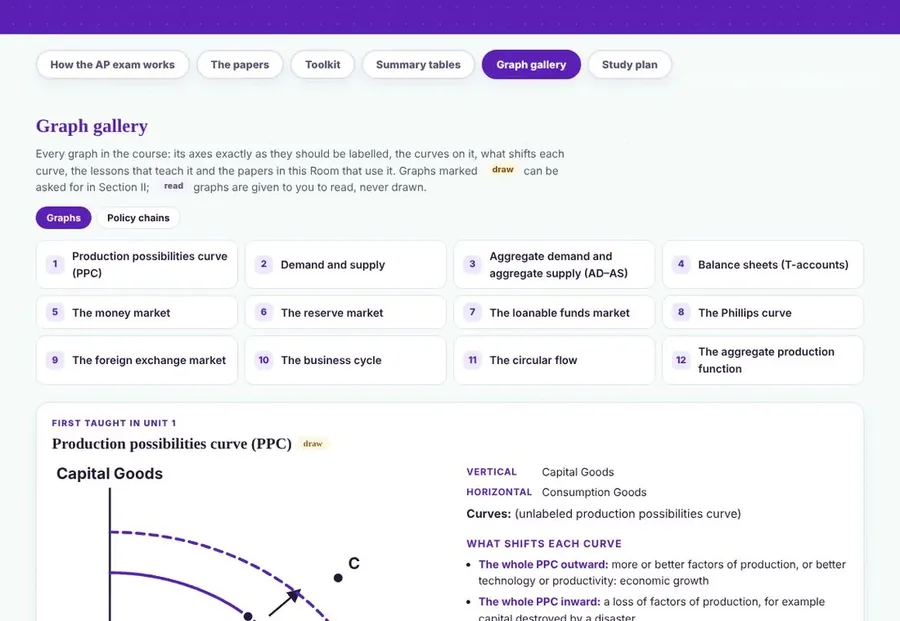
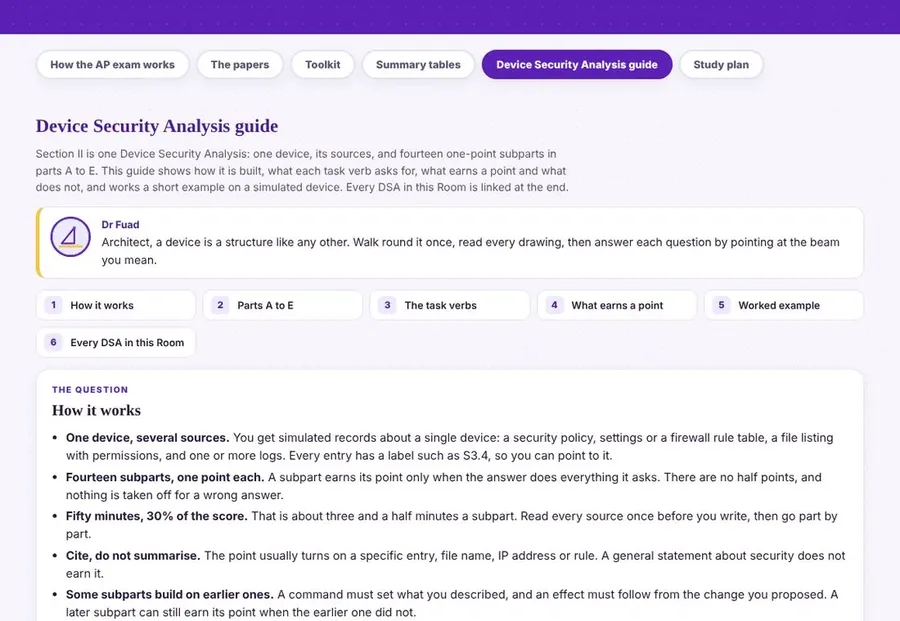
Every AP course has its own Exam Room: unit tests, practice papers and two full mock exams with Section I and Section II, timed like the AP exam. Every answer is marked on our servers, and written answers are marked against the course author’s marking points, one point at a time.
- 569papers across 8 courses
- 2,510written parts with model answers
- Section I + IItimed like the AP exam
Eight rooms, five mentors
One Exam Room for every AP course
Each course has a room of its own, led by its mentor: its own papers, timing and calculator rule, with a toolkit and a study plan built for that exam.

Microeconomics

Macroeconomics

Biology
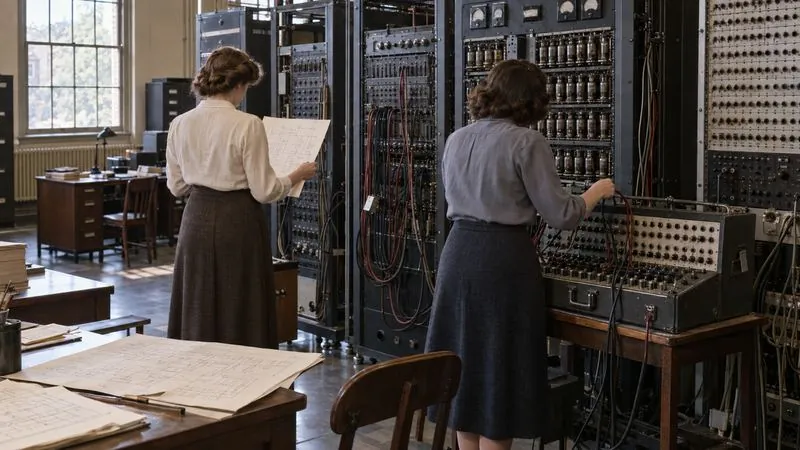
CS Principles

Cybersecurity

Psychology

Precalculus
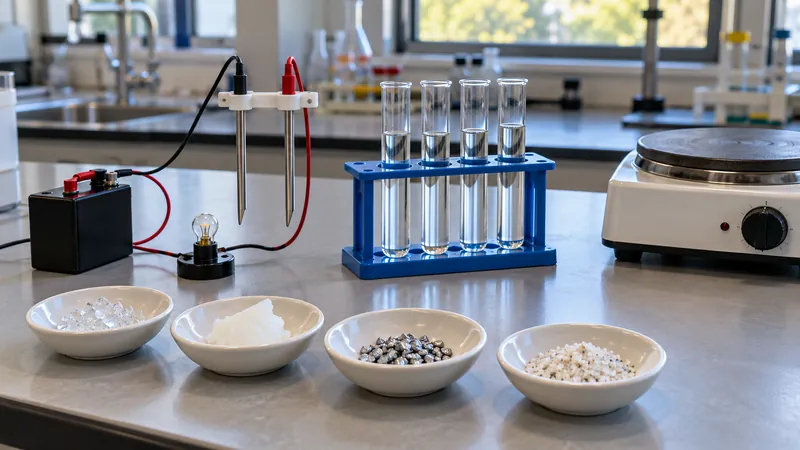
Chemistry
Explore the rooms
Pick a course, see its exam
Each room follows its course’s exam: the sections, the number of questions, the minutes, the calculator rule and the AP skills the report measures.
Choose a course
AP Microeconomics · Exam Room
55 papers
6 unit tests · 47 practice papers · 2 full mock exams
Full mock exam
Section I
60 multiple-choice questions
1 h 10 min
Section II
3 free-response questions
1 h
- Calculator
- Four-function calculator allowed; no formula sheet
- AP skills in the report
- 4 skill categories
- In this room
- How the AP exam works, a toolkit and a study plan
Total mock time: 2 h 10 min. Unit tests and practice papers are shorter, each with its own timing.
Inside a room
Three kinds of paper in every room

Unit tests
One per unitA shorter paper on one unit, with its own timing. Micro Unit 1, for example, is 24 multiple-choice questions in 28 minutes, then 3 free-response questions in 60. CS Principles’ unit tests are Section I only.

Practice papers
Many per courseExam-style papers to sit again and again, from 23 in Biology to 109 in Chemistry, each with the same pass line as a unit test.

Full mock exams
Two per courseThe whole exam at full length and full timing, Section I then Section II, for a true rehearsal before May.
See how it works
A mock exam, step by step
Every paper follows the same four steps, in each course’s real exam format.
Section I · multiple choice
The real number of questions and options, a live timer, and a map of every question to move between them.
Section II · free response
Each course’s real format, from drawn graphs to code and article analysis.
Mark Section II
Every point is marked against the author’s marking points: graphs, numbers and picks as well as written answers, each beside the model answer.
The report
Scores by section, skill and unit, and every missed question with the right answer and why.
Section II · written answers
Marked point by point, never self-marked
Every written part has a model answer and the author’s marking points. Each point is judged on its own: an answer that contradicts itself does not earn it. Pick a sample answer to see how it is marked.
Pick a student answer
AP Microeconomics · Section II · Part (b) · 2 points
The government places a per-unit tax on sellers of coffee. (i) State what happens to the price buyers pay. (ii) Explain what happens to consumer surplus.
Student’s answer
The price buyers pay goes up.
Point 1 · Price paid by buyers rises: earned
States that the price buyers pay rises.
Point 2 · Consumer surplus falls, with a reason: not earned
Consumer surplus is not mentioned, so the explanation point cannot be earned.
1 / 2
Each point is judged on its own. Only what is written earns marks.
Question types
Every format the AP exam uses
Multiple choice
Section IOne right answer, with the same number of options as the course’s AP exam, at the exam’s pace.
Select all that apply
Section IRight only with exactly the right picks, none missing and none extra, in courses whose exam uses this format.
Number entry
Section IType the calculated value; it is checked on our servers against the accepted range.
Free-response parts
Section IIDescribe, explain, calculate, justify: each part marked against its own points.
Data questions
Section IIRead a graph, table or experiment, then answer from the evidence.
Linked to the framework
TaggedEvery question carries its essential knowledge and AP skill, so the report can show each AP skill and each unit.
The report
A clear result, and what to do next
After hand-in, students and parents see all of this:
What students and parents see
After hand-in- The scoreThe paper’s total, out of every point available.
- Each sectionSection I and Section II, each with its own score.
- Each AP skillHow each skill category went, so the weak ones stand out.
- Each unitStrong, Getting there or Needs focus, unit by unit.
- The time usedHow long the paper took.
- Every miss, with the answer and whyThe right answer and the reason, and every written point with its mark.
The pass line
70%overall
and50%in every skill category
For unit tests and practice papers: shown as Unit test passed or Not passed yet. Mock exams have no pass line: they show where you stand.
Each unit’s standing
- Strong70% and above
- Getting there50% to 69%
- Needs focusbelow 50%
Inside every Exam Room
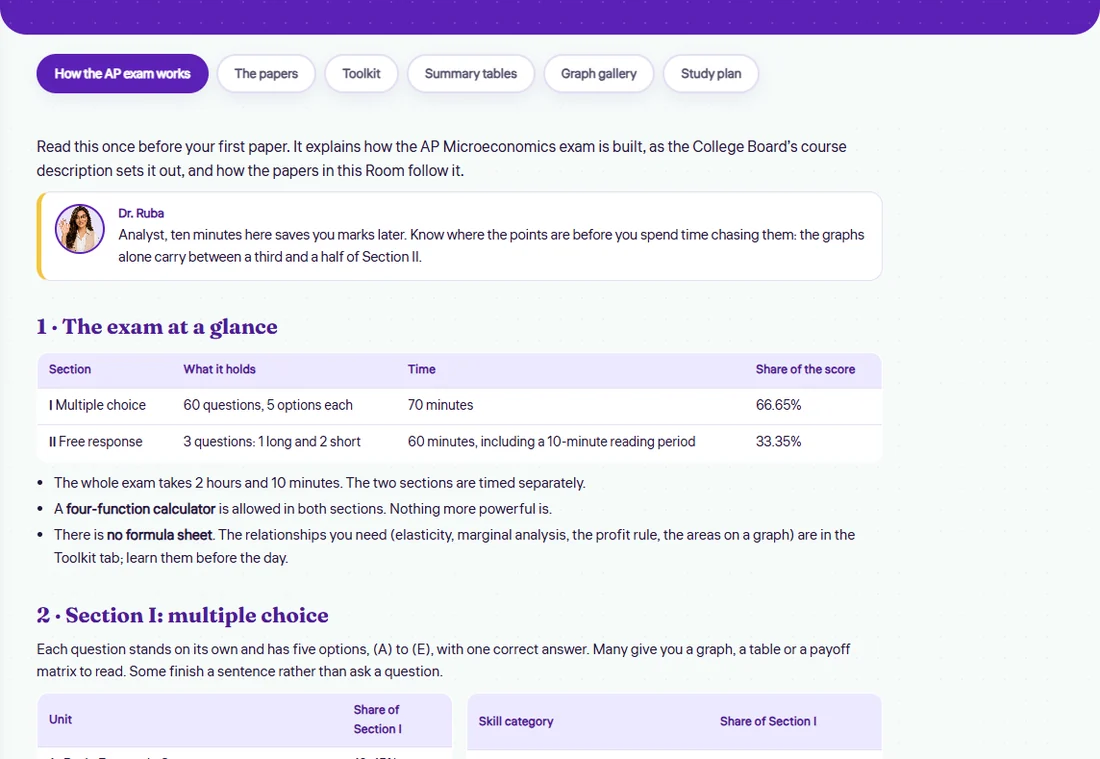
Six tabs to get exam-ready
Every Exam Room has six tabs: how the exam works, the papers, a Toolkit, summary tables, its own course guide and a study plan. Tap through the tabs and each course’s guide.
In every lesson too
The lesson’s own Exam Room tab
Every AP lesson ends with a short timed sitting, drawn fresh from that lesson’s question bank at real exam pace and marked only when it is handed in. Before it, the Challenge tab puts the lesson into a free-response case: Yes/No statements marked one at a time, and written parts marked against their points.
Then the lesson’s Revise links open the room’s tables and papers, to take it further across the whole course.
Fair and secure
Exam rules, built in
Timed like the exam
Clocked to the exam's paceEach paper has the minutes its author set for Section I and Section II, and a section is handed in for you when its time runs out.
The right calculator
As each course allowsAn on-screen calculator in Microeconomics, Macroeconomics and Biology (four-function in economics); none in CSP, Cybersecurity or Psychology.
Answers stay on our servers
Marked at hand-inNo answer key reaches the student’s browser during a sitting. Every answer is marked on our servers when the paper is handed in.
Checked before students see it
Authors check every questionA question that has not yet passed the authors’ check is held back, so students never see it.
Questions
What parents ask about the Exam Room
Which AP courses have an Exam Room?
All eight: Microeconomics, Macroeconomics, Biology, Chemistry, Precalculus, Computer Science Principles, Cybersecurity and Psychology.
Can my child sit a paper again?
Yes. Every paper can be sat again and the best score is kept. A written part is marked once: on a new try it keeps its first mark.
Will 3Roots predict my child’s AP score from 1 to 5?
No. The real AP exam is scored from 1 to 5, but the College Board doesn’t publish how marks turn into that score, and the cut-offs change every year. Any prediction would be a guess. Instead, every report shows real results: each section, each skill and each unit, measured against a clear pass line.
Can I see my child’s results?
Yes. Every paper’s report, and the course report across all their papers, is on your Assessment reports page.